125 Grizzly

125 Grizzly

Overall Score: 81/100

Tested April 2019

We earn a commission for products purchased through some links in this article.

The Bosch Universal Aquatak 125 is a lightweight pressure washer which cleans effectively and efficiently. What we love about this pressure washer is you can store all your accessories on board and it even has a storage compartment at the front where you can store your interchangeable nozzles.

It performs well when used to tackle stubborn dirt and grime on patios and it leaves your patio looking brand new. Thanks to its compact size and great storage options, it's ideal for any home and garden who have little or large storage space. The price is also reasonable for impressive performance.

£123.90

Flag,

Quiet Mark

Loud - this product has been scientifically assessed and found to be louder than most in this category.


GHI EXPERT VERDICT

The Bosch Universal Aquatak 125 is easy to use, great for storage and has a lightweight design that makes it easy to transport around your home. It comes with a range of accessories, including a detergent bottle and a 3-in-1 nozzle. It has everything you need to clean your patios, windows and even the most stubborn outdoor cleaning tasks.

We found it did best when it was used to tackle overgrown algae and grime on patios. It mostly cleaned it all away and takes a short time to complete. We did notice there were a few streaks left over from where we used a lot of pressure. There's also a small amount of splashing.

But, we also used the pressure washer to clean our car and it did a good job. It cleans the car well and is fairly easy to manoeuvre around the car exterior. The attachments are a little stiff to attach, but the overall assembly of the pressure washer is easy.

Overall, the Bosch Universal Aquatak 125 is ideal for those who want a reliable and effective pressure washer. It's great for storage and comes with everything you need.

KEY SPECIFICATIONS

  • Weight: 6.55kg
  • Power Output: 1500w
  • Max.Pressure: 125 bar
  • Max. Flow Rate: 360l/hr
  • Hose Length: 5m
  • Cord Length: 5m

    RATINGS

    • Ease of use: 4.5/5
    • Design: 5/5
    • Instructions: 4/5
    • Performance: 3.8/5

      WE LIKED

      • It is very lightweight
      • Easy to transport
      • It comes with a detergent bottle

        WE DIDN'T LIKE

        • The lance can become heavy while in use
        • A lot of smears left on windows after cleaning
        • Leaves some smears on patio which you have to go back over

          All product information provided by the manufacturer is correct at time of publication.

          This content is created and maintained by a third party, and imported onto this page to help users provide their email addresses. You may be able to find more information about this and similar content at piano.io

          125 Grizzly

          Source: https://www.goodhousekeeping.com/uk/product-reviews/house-garden/a28273221/bosch-universal-aquatak-125-review/

          Share:

          2019 Harley Davidson Fat Bob 114 Review

          2019 Harley Davidson Fat Bob 114 Review

          With the demise of the FXDR and the V-Rod, the 2021 Harley-Davidson Fat Bob 114 inherits the mantle of the hot-rod cruiser from The Motor Company. With bobbed fenders, fat 16-inch tires, exposed air-filter, and a robust exhaust system, the Fat Bob 114 looks the part of a tough-guy boulevard brawler.

          2021 Harley-Davidson Fat Bob 114 Review: Prcie

          There's no doubt the Fat Bob 114 delivers the performance goods around town. A pavement rippling 118 ft-lbs of torque is produced at just 3500 rpm, so acceleration is always at your beck and call. Thanks to a slow-turn throttle, the Milwaukee-Eight 114 isn't jumpy—it's insistent. Twist the throttle, and you gain mph at a rate that is as smooth as it is impressive—don't worry, there's still enough V-twin purr to keep you content. While there may be some competition for you at the stoplights, it will take a dedicated opponent to shut you down when the light turns green.

          The ergonomics of the 2021 Harley-Davidson Fat Bob 114 are perfect for the stoplight antics. You're firmly entrenched in the all-day comfortable seat with your legs forward, though not excessively so. The grips are about where you'd like them to be for riding, if not profiling. The seating position gives you a feeling of comfort and authority. You know you can move out quickly and look good doing it—the hallmarks of a great motorcycle.

          2021 Harley-Davidson Fat Bob 114 Review: MSRP

          Of course, riding in an urban environment is about more than dashing from stop to stop. You have to deal with road irregularities and traffic, and the Fat Bob arrives at the city limits ready for the demolition derby.

          It may look like a low, mean cruiser—and it is. However, there is some suspension travel lurking beyond that 28-inch seat height. The rear wheel gets 4.4 inches of travel thanks to a smartly damped and sprung shock—spring preload is adjustable via a knob, should you carry a passenger. The fork gives you over five inches of travel. Add to that the high-profile Dunlops with Harley-Davidson branding, and you have plenty of protection from potholes, dips, and railroad crossings.

          2021 Harley-Davidson Fat Bob 114 Review: Colors

          The suspension is at its most impressive on battered urban freeways, which feature seamed concrete slabs that can feel as whooped out as Glen Helen after an all-day pounding. Between the Fat Bob's geometry, suspension, and tires, the chassis makes short work of the obstacles, while the power allows you to go as fast as you like. Moving into position on the freeway is a pleasure, with the vast dollops of torque at any rpm, plus the stability of the 63.6-inch wheelbase and, again, the Fat Bob's fat Dunlops.

          Our test bike had a Wind Splitter H-D Detachable Compact 15-inch Windshield installed. Although it might not look like much, the $420 accessory keeps a ton of freeway windblast off your chest. Really, at anything above 35 mph, you'll notice how much wind is being displaced. Around town in the summer, you will want to pull it off to increase airflow—a no-tool job. If you do a decent amount of freeway work, it's a nice add-on.

          2021 Harley-Davidson Fat Bob 114 Review: Windshield

          In close quarters, the Fat Bob is agile enough for filtering to the front of any red-light line-up. Working your way through traffic requires a bit of muscle to coax the 676-pound motorcycle to go where you want it to go. The wide handlebar has an odd downward droop that counteracts bar risers, but it works. While 114 cubes could be considered overkill for urban prowling, the big V-twin is docile enough if you have even the slightest semblance of throttle control. If you need the massive power, it's only a wrist-twist away.

          Perhaps a secret identity of the 2021 Harley-Davidson Fat Bob 114 is that it's quite fun when it's time to carve up the canyons. If you're the type of rider who knows how to exploit torque and stability, the Fat Bob is quite rewarding. The chunky Dunlops provide plenty of traction all the way to your heels touching down, which happens later than you think—cornering clearance will be satisfactory for most riders.

          2021 Harley-Davidson Fat Bob 114 Review: Specs

          Braking is an interesting proposition on Harley-Davidson cruisers. Some have a strong rear-brake that gets lots of use—others, not so much. Put the Fat Bob 114 down as one of the not-so-strong rear brake H-Ds. For those who don't care about the back brake, you're in luck—the twin 300mm discs on the front wheel have four-piston calipers doing the business. With the Dunlop's wide footprint, the front is capable of serious deceleration without triggering the ABS.

          2021 Harley-Davidson Fat Bob 114 Review: For Sale

          Riders who like to constantly monitor their speed will not be happy with the tank-mounted round display. The tachometer takes over most of the real estate, and I never feel the need to know what rpm the motor is at—I can tell by feel. The speed is a small digital display in an unreadable position if you have a full-face helmet on. I'm a full-face guy, so about the only time I check out the dash is at a stop. Actually, most of the time I'm on a fruitless quest to find neutral. The transmission must be tied to the signals, as I always seem to find N just as the light turns green.

          The 2021 Harley-Davidson Fat Bob 114 is great fun to ride, and you can present yourself as the hottest of hot rods, if you prefer. No one needs to know that the beastly motor can be a pussycat, and you're pampered by the suspension, seat, and ergonomics.

          Photography by Kelly Callan

          RIDING STYLE

          • Helmet: Arai Defiant-X
          • Jacket: The Trans-Am by Cortech
          • Back protection: Fly Racing Barricade Back
          • Gloves: Tourmaster Gel Cruiser
          • Jeans: The Ventura by Cortech
          • Shoes: Harley-Davidson Tremont Waterproof

          2021 Harley-Davidson Fat Bob 114 Specs

          ENGINE

          • Type: Milwaukee-Eight 114 V-twin
          • Displacement: 114ci (1868cc)
          • Bore x stroke: 4.016" x 4.5" (102 x 114mm)
          • Maximum torque: 118 ft-lbs @ 3500 rpm
          • Compression ratio: 10.5:1
          • Valvetrain: Single-cam; 4 vpc
          • Lubrication: Dry sump
          • Exhaust: 2-1-2; catalyst in muffler
          • Cooling: Air and oil
          • Transmission: 6-speed Cruise Drive
          • Primary drive: Chain
          • Final drive: Belt

          CHASSIS

          • Front suspension; travel: Non-adjustable 43mm inverted cartridge fork w/ triple-rate springs; 5.1 inches
          • Rear suspension; travel: Spring-preload adjustable shock; 4.4 inches
          • Wheels: Cast aluminum
          • Front: 16 x 3
          • Rear: 16 x 5
          • Tires: Dunlop Harley-Davidson
          • Front tire: 150/80 x 16
          • Rear tire: 180/70 x 16
          • Front brakes: 300mm discs w/ 4-piston calipers
          • Rear brake: 292mm disc w/ 2 piston caliper
          • ABS: Standard

          DIMENSIONS and CAPACITIES

          • Wheelbase: 63.6 inches
          • Rake: 28 degrees
          • Trail: 5.2 inches
          • Seat height: 28 inches
          • Fuel capacity: 3.6 gallons
          • Estimated fuel consumption: 47 mpg
          • Curb weight: 676 pounds

          2021 Harley-Davidson Fat Bob 114 Colors and Prices

          • Vivid Black: $18,799 MSRP
          • Billiard Red; Deadwood Green Denim: $19,199 MSRP
          • Price as tested: $19,219 MSP

          2021 Harley-Davidson Fat Bob 114 Review Images

          2019 Harley Davidson Fat Bob 114 Review

          Source: https://ultimatemotorcycling.com/2021/09/28/2021-harley-davidson-fat-bob-114-review-hot-rod-cruiser/

          Share:

          Jd3 Rockzilla

          Jd3 Rockzilla

          Offroad car actually has a great body, an injection of abundant energy, as well as extreme suspension system so as to pass through unusual terrain, such as rocks and sloping terrain. So it was probably the idea of ​​off-road car modification is made.

          Is JD3 as companies were implicated in the modification of cars become frightening and impressive offroad look lumpy.

          But who would have thought that this car is an 'evolution' of the Ford Excursion, a work car Ford SUV format, which basically has the appearance of 'humble'.

          The car is named after RockZilla, as the name suggests, the car was modified as extreme as possible so as to give the impression of 'monsters', sounding clear from the name 'Zilla' given by JD3.

          Outside the original body of the Ford Excursion is completely eliminated entirely. Replaced with a steel frame that makes it look like a war vehicle. The size is also getting looks great, especially with the addition of large diameter wheels bigfoot style.

          Rockzilla equipped with fuel tank size of 166 liters, which is capable of carrying passengers to the extent of more than 644 km. This car has been sold legally and can be bought, but not necessarily be incorporated into Indonesia.

          JD3 Rockzilla released that can be bought at varying prices. If we want to modify our cars become Rockzilla, prices range from $ 50,000 or approximately USD 580 million. But if we want to buy it in its finished form, it costs about $ 72,000, or nearly $ 800 million.

          Jd3 Rockzilla

          Source: http://hey-rara.blogspot.com/2014/09/modification-of-most-extreme-off-road.html

          Share:

          Old Cholo Cars

          Old Cholo Cars

          The Ins and Outs of Buying Classic Cars

          CC0/ PixelLightMedia/Pixabay

          The difference between an old car and a classic is clear if you're a car enthusiast. Some enthusiasts say that a car has to be over ten years old to be a classic. Others say that anything from a marque like Ferrari or Lamborghini is an instant classic. The point is that there's no way of defining exactly what makes a car a classic, although most believe that a classic is generally a car that's no longer in production and has been restored or maintained in the best condition possible.

          Vintage Cars

          Vintage cars can be classified as classics, antiques or collectables. Collectables is the term car clubs attach to modern hyper-cars and supercars that were produced recently. Whether a car is still in production or if it's recently ceased production, the car is normally considered a collectable model. It will become a classic later. Classic is the next definition car clubs like to use when describing important cars. These cars are normally at least thirty years old. That means they've been lovingly maintained or restored by careful owners. The definition "antique" is normally reserved for cars from the 1940s and earlier. These are cars that really show how the automobile has evolved over time.

          How Much Should You Pay?

          Whether you're looking to buy or trying to value your classic, you need to understand the market. The basics of selling are supply versus demand. An internet search will tell you if the car you're buying or selling is in demand at that time but it won't tell you what price to aim for. You'll need to consult a recognized classic car price guide to find out what your car's worth. Used car sellers consult a price guide to figure out what to charge for a car based on its age, mileage and condition. Buying and selling classics works the same way. Search online and you'll find the tools you need to establish the vehicle's price.

          Classic Car Calendar

          If you're beginning to take an interest in classic cars, check out a classic car show in your area. Some of the best like the Pebble Beach Concours d'Elegance in California and The Woodward Dream Cruise in Detroit are worth driving to at least once in your lifetime even if you live hundreds of miles away, but to begin with look locally for shows. You'll find that classic car owners are very pleased to talk about their vehicles and share their knowledge so this is a very good way of getting an understanding of the market.

          Classic Car Shows Near You

          Use social media and other websites to find out the classic car shows near you that are worth visiting. Some are ticketed events. Others are run as part of a local fair. If you're beginning to show an interest in classics, visit as many as you can. They're a great day out for anyone with an interest in cars. Even if you chose not to buy a classic in the end, you'll get to enjoy a range of great era-defining automobiles.

          Classic Car Raffle

          If you've not heard of this before, you might not believe us when we tell you that classic car museums and car clubs sometimes run car raffles to raise funds for other projects. Perhaps the museum has a model that no longer draws the crowds but can make some cash to help the place continue to run or to renovate another car. In those circumstances, a raffle makes a lot of sense, and from a customer's point of view, they get the chance to win a car for a few dollars. As with classic car shows, these events are great places to meet people in the business of restoring and selling classic vehicles.

          A Classic is an Old Car

          Let's not forget that a classic car is an old car that means it will need a lot of love, care and attention to maintain it. Classics also take up a lot of your time so if you have a growing family or an elderly relative that needs your attention, perhaps you should wait before buying that Pontiac GTO or Chevrolet Camaro you've been dreaming off since you were a child. An older car can be a massive financial drain as well. Don't kid yourself that you'll make back the money you put into the car. The truth is that even if you sell it for a little more than you bought it for, the profit won't cover the amount you spent at the shop. This has to be a hobby not a project unless you really know a lot about classics and cars in general.

          Old Cholo Cars

          Source: https://www.life123.com/lifestyle/cars-and-driving/the-ins-and-outs-of-buying-classic-cars?utm_content=params%3Ao%3D740009%26ad%3DdirN%26qo%3DserpIndex

          Share:

          Fortis Spaceleader Chronograph By Volkswagen Design

          Fortis Spaceleader Chronograph By Volkswagen Design

          Fortis

          HISTORY

          •  1992

          The watch factory is founded in Grenchen, Switzerland by Walter Vogt.

          • 1926

          Series production of the world's first self-winding wristwatch, the legendary HARWOOD.

          • 1937

          On the occasion of the company's 25th anniversary, FORTIS manufactures the First Chronographs.

          • 1943

          FORTIS was among the range of Swiss brands with high technical expertise. Alongside the production of most precise mechanical chronographs Fortis shows its excellence in presenting the first water-resistant wristwatches.

          • 1956

          FORTIS wins the leading Chronometer award conferred by the Swiss institute for official time keeping tests, for the first water-resistant alarm chronometer.

          • 1958

          600 watchmakers and representatives of the watchmaking collective met in Tokio and celebrated the so called "FORTIS day" in the Yamaha Hall on November 26th. The FORTIS representatives presented the new electronic regulation system "BEP".

          • 1959

          In India FORTIS is one of the most popular brands.

          • 1962

          The Spacematic Automatic, constructed for extreme conditions and temperature changes was tested by the seven members of an US space mission.

          FORTIS anniversary 50 years: presentation of the jubilee model "Stratoliner"

          • 1965

          FORTIS presents, as one of the first Swiss watch makers, a synthetic quartz watch, the "FLIPPER".

          • 1975

          "FLIPPER quartz leader"- a new concept of the watch as a stylish accessoire, the original FORTIS CONTAINER® SWISS with easy to change coloured bracelets. Well known carriers were e.g.the Rolling Stones, Roman Polanski, Leonard Bernstein, Roger Moore.
          „The aristocrats of the plastic watches...", the international press of the 80es characterizes.

          • 1987

          The company's 75th anniversary FORTIS sets a trend with its new edition of the Flieger Automatic collection.

          • 1988

          Awarded two times with the iF product design award.

          • 1994

          After endurance tests on the borderline of modern physics, the Star City Training Center chose the FORTIS OFFICIAL COSMONAUTS CHRONOGRAPH as part of their Official Cosmonauts' equipment. The space mission "Euromir 1"crew was the first to be presented with the FORTIS COSMONAUTS SET and became the world's first automatic chrongraph in open space outside the space station.

          • 1995

          The world height record - 100,000 feet. The FORTIS chronographs were on the pilots' wrists as they set the world height record flight on a -non experimental- MiG-25 PU double seater aircraft, flown by Alexander Garnaev and Alexander Parringaux.

          • 1997

          The FORTIS OFFICIAL COSMONAUTS CHRONOGRAPH was chosen to be the official watch of the German-Russian space mission MIR 97.

          • 1998

          The world's first Automatic Chronograph with integrated Mechanical Alarm. EP 0806712.

          • 2000

          Millennium Expedition to the South Pole New Year's Eve 1999-2000: Austrian Ernst Zinnhobler became the first European to make an extreme jump over the South Pole.
          He jumped from the icy height of 5,000 meters, his speed of fall reaching 250 km/h accompanied by a FORTIS OFFICIAL COSMONAUTS CHRONOGRAPH.

          FORTIS SPACEMATIC - The Next Generation. With this collection, FORTIS takes a giant step into the new millennium.

          • 2001

          "GTS" Global Transmission Services.
          The first experiment on board the International Space Station (ISS) was to test the global synchronization of wristwatches from space. FORTIS takes part in the development of a new radio-controlled signal in cooperation with the European space agency (ESA), the German agency for air and space travel (DLR), and DaimlerChrysler.

          No. 1 International Watch Award in Japan.
          The FORTIS OFFICIAL COSMONAUTS CHRONOGRAPH won the watch magazine "BEGIN" grand prix in the category for space watches.

          "Star of the blue planet". FORTIS was presented with this medal of honor from the Russian Space Agency Roskosmos for commitment to the development of mechanical chronographs for space travel.

          PILOT PROFESSIONAL CHRONOGRAPH became the official watch of the Hungarian Air Force

          • 2002

          World height record for helicopters of 12,954 meters set by French pilot Fred North with his AS 350B helicopter "ecureuil". Along for the ride: the FORTIS B-42 PILOT PROFESSIONAL CHRONOGRAPH.

          • 2003

          Presentation of the new FORTIS OFFICIAL COSMONAUTS CHRONOGRAPH in the striking B-42 design.

          • 2004

          Exactly 10 years after the first official flight FORTIS is reconfirmed as the exclusive supplier of manned space missions authorized by ROSKOSMOS, the Federal Space Agency. The B-42 OFFICIAL COSMONAUTS CHRONOGRAPH floating in space on board the ISS.

          Winner "1st European Aviation Watch Award": FORTIS FLIEGER CHRONOGRAPH

          Four years, more than 700 days walking through 11,000 km of Arctic Tundra, 10 million footsteps in the snow of four winters. Gilles Elkaim approached his final 28 km stretch of this unique expedition with excitement. On this wild and unforgiving trek from the Atlantic to the Pacific Ocean, the Frenchman wore the FORTIS Official Cosmonaut Chronograph.

          • 2006

          The high altitude research rocket MAXUS 7 was launched in May for a 13-minute flight in zero gravity. On board, the FORTIS B-42 Official Cosmonaut Chronograph.

          • 2007

          The FORTIS B-42 PILOT PROFESSIONAL CHRONOGRAPH accompanies Georg Csak and Dominik Rind during their 35-day Arctic Summits expedition.

          15 years after the first test in Star City, the third generation of B-42 automatic chronographs accompanies the construction of the ISS.

          The Portuguese Air Force decided on FORTIS FLIEGER Chronographs as their jubilee edition to celebrate the 50th anniversary of the Brisontes squadron.

          Limited Edition FORTIS FLIEGER CHRONOGRAPH PLATINUM alarm wins 2nd place "Golden Balance" award in the category "Up to 25,000 Euro"

          • 2008

          Successful world premiere of the GTS signal reception during the Hanover Fair's special exhibition, Spacetransfer 08.

          The FORTIS B-42 OFFICIAL COSMONAUTS CHRONOGRAPH TITAN CARBON accompanies the preparation of the docking manoeuvre for the European research module COLUMBUS on board the international space station ISS.

          FORTIS reaches 2nd places in two categories as the best watches of the year 2008 „The Golden Balance Wheel": FORTIS FLIEGER CHRONOGRAPH ALARM PLATIN and the new FORTIS B-42 FLIEGER ALARM.

          Four kinetic sculptures of the Swiss Artist Jean Tinguely crowned the oldtimer exhibition held at the Automobile Club de Monaco. SAS Albert II The Prince of Monaco received the no. 1 out of 100 of a limited watch edition named PIT STOP.

          • 2009

          The FORTIS SPACELEADER by Volkswagen Design wins the "GOOD DESIGN AWARD" 2009 of the Athenaeum Museum Chicago. The GOOD DESIGN award is the oldest and most renowned design prize of the world. It was constituted in 1950 by the architects Eero Saarinen, Charles and Ray Eames as well as the former curator of the MoMA, Edgar Kaufmann jr.

          MARS 500 with FORTIS. To simulate a space mission to MARS, 6 test persons spend 105 days in the closed circuit of the space lab Mars 500. FORTIS is the official mission supplier and creates the special B-42 OFFICIAL COSOMONAUTS MARS 500 TITANIUM in a Limited Edition.

          FORTIS wins 2nd place in the "aerokurier" (German aviation magazine) reader's choice "Best Brands 2010" in the category "aviation watches".

          • 2010

          The FORTIS SPACELEADER by Volkswagen Design is nominated for the official design award of the Federal Republic of Germany 2010. The nominees are chosen by governmental departments and cannot apply for the prize by themselves.

          On June 3rd, the ESA, the Federal Space Agency FSA and the IMBP (Institute for Biomedical Problems) will send 6 probands on a mission to planet MARS.
          This real-time simulation started in Moscow and the hatchway isolates the crew from the rest of the world for 520 days. FORTIS creates the special B-42 BLACK MARS 500 watch in a Limited Edition.

          The FORTIS SPACELEADER by Volkswagen Design is awarded with the RED DOT honourable mention 2010. The red dot design award is a large and coveted international product design prize awarded by the Design Zentrum Nordrhein Westfalen in Essen, Germany, since 1955 this design centre marks outstanding international product designs with its well known RED DOT.

          The FORTIS SPACELEADER by Volkswagen Design wins iF product design award 2010. This prize, awarded by international experts, is trusted world wide and denotes proven design quality.

          • 2011

          End of the Mars 500 mission. On the 4th of November the door of the space habitat opened after 520 days.

          The FORTIS SPACELEADER by Volkswagen Design is nominated for the second time for the official design award of the Federal Republic of Germany 2012.

          The B-47 BIG BLACK is awarded with the Good Design Award 2011.

          • 2013

          At the Cultural Historical Museum Grenchen, Switzerland the FORTIS centennial exposition is held from March until September entitled "From Grenchen into Space - 100 Years FORTIS", a time travel right into the brands' exciting history.

          On the occasion of the 100th anniversary FORTIS presents the new Chronograph Alarm GMT Automatic calibre F-2012 with two power reserves and indications for a 2nd time zone and AM/PM indication: The masterpiece: F-43 FLIEGER CHRONOGRAPH ALARM GMT Chronometer C.O.S.C.

          Fortis Spaceleader Chronograph By Volkswagen Design

          Source: https://danys.com.ua/en/catalog/12/info/hist/

          Share:

          1961 Lincoln

          1961 Lincoln

          Although Lincoln's earliest cars were dismissed as homely, in the decades to come, it would spawn some of the most respected and memorable designs in the automotive industry. This week, we take a look at one of Lincoln's finest stylistic achievements, the elegant and understated 1961–1963 Lincoln Continental.
          1963 Lincoln Continental hood ornament

          EDSEL'S CONTINENTAL

          When Henry Martyn Leland first conceived the Lincoln automobile in 1919, he declared that his goal was to build the world's finest motor car. Astute readers will note, however, that he said nothing about building a beautiful car. While the engineering and workmanship of the early Lincoln left little to be desired, its lackluster styling contributed to mediocre sales, which hastened the company's descent into receivership in 1921 and subsequent purchase by the Ford Motor Company.

          By the late 1930s, with the Leland-engineered Lincoln Model L gone and the subsequent Model K fading away, the situation had been reversed. Hobbled by Henry Ford's penury and eccentricity, Lincolns now lagged the industry in many areas of engineering. The popular Lincoln-Zephyr line had relatively advanced semi-unitary construction, but it was saddled with Ford's traditional beam-axle front suspension and a troublesome flathead V-12 engine whose unhappy reputation would probably have made the perfectionist Henry Leland contemplate ritual suicide. On the other hand, thanks to the taste and refinement of Lincoln president Edsel Ford, Lincolns had exceptional styling — even trumping GM's Harley Earl with advanced features like integrated headlamps.

          Edsel's finest aesthetic achievement was the Continental. Styled by E.T. (Bob) Gregorie, it was essentially a tastefully customized 1939 Zephyr created for the personal use of Edsel Ford. Although intended as a one-off, it soon attracted the attention of Edsel's well-heeled friends, who inquired how they could get one of their own. The Continental was introduced as a production model in 1940. Sold in very limited numbers, it was nonetheless widely admired, with fans that included noted architect Frank Lloyd Wright. A heavy-handed facelift spoiled the looks in 1942, but the Continental survived until 1948 and remains among the only postwar cars to be acclaimed a true Classic by the Classic Car Club of America.
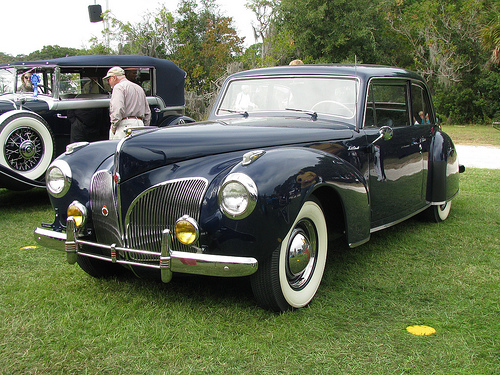
          1941 Lincoln Continental front 3q
          The original Lincoln Continental was a convertible, although the production version was available either as a club coupe or cabriolet. The former was the better seller, although that meant only 350 units in 1940 and an additional 850 for 1941. High prices were the major reason for slow sales — the coupe cost $2,812, nearly 30% more than a Cadillac Sixty Special. Although the Continental had a V-12 engine, a rarity for an American car by that point, the 292 cu. in. (4,787 cc) engine was troublesome and had 30 fewer horsepower than Cadillac's V-8. (Photo: "1941 Lincoln Continental" © 2008 Imperturbe, used with permission)

          Edsel died in 1943 and two years later, his son, Henry Ford II, assumed control of Ford Motor Company, which was by then in very dire straits. Limited resources and organizational chaos led to odd-looking, half-hearted late-forties Lincolns that excelled neither mechanically nor stylistically.

          THE CONTINENTAL MARK II

          In 1955, Ford decided to revive the Continental, this time transforming it into its own separate marque, distinct from Lincoln. The result was the 1956–1957 Continental Mark II, a low-slung two-door hardtop coupe with a finely detailed interior. The Mark II was widely considered a stylistic triumph, hailed as a welcome break from the typical ostentation of the period. Except for its rather contrived decklid hump (an homage to the original Continental's exposed spare wheel), the Mark II was understated and elegant. Its engineering was again very conventional, but it was a monument to refined taste that Edsel Ford would likely have approved.

          Alas, the Mark II's critical adulation did not translate into sales success. Sales for the two years were fewer than 1,800 and Ford lost about $1,000 on each one. The Mark II was discontinued after only two model years and its successor, the 1958 Continental Mark III, was little more than a lavishly trimmed, over-decorated version of the standard Lincoln. The Continental division, which had never really gotten off the ground, was shuttered in July 1956 and rolled into Lincoln-Mercury division.

          1957 Continental Mark II rear 3q 1996 Robert Nichols-per
          Despite an impressive roster of celebrity clientele, ranging from Frank Sinatra to the Shah of Iran, sales of the 1956 Continental Mark II were only 1,325, dropping to a grim 444 for 1957. Towering prices did not help; at around $10,000, the Mark II was more than twice as expensive as the Lincoln Premiere, itself far from cheap in those days. (Photo © 1996 Robert Nichols; used with permission)

          Lincoln itself nearly went the same way. Its 1950s sales had never been terribly impressive and its 1958 models were an expensive flop. Lincoln's losses for 1958–1960 ultimately totaled around $60 million and that did not include the losses of the Continental division or of Edsel, which was rolled into a new Mercury-Edsel-Lincoln division in January 1958.

          THE FASHION CONSCIOUSNESS OF ROBERT MCNAMARA

          Automotive historians love to repeat the conventional wisdom that Robert McNamara was oblivious to styling and thought all cars should be boxy and utilitarian, like the compact Ford Falcon. That characterization is not really supported by the recollections of Ford stylists of the era, including Bill Boyer, John Najjar, and Gene Bordinat. It's certainly true that McNamara lacked a sophisticated understanding of automotive design; according to Najjar, the designers often had to educate McNamara on the technical aspects of their craft. McNamara also had a distaste for unprofitable, limited-production halo cars like the Continental Mark II. Nevertheless, former senior stylist Elwood Engel later noted that McNamara was surprisingly style-conscious; some of the products McNamara championed proved to be highly influential stylistic milestones. In fact, McNamara's style consciousness helped to save Lincoln from the chopping block.

          Earlier in the year, Elwood Engel, the head of Ford's advanced design studio — a narrow basement room that stylist Colin Neale dubbed "the stiletto studio" — had been working on an alternative concept for the 1961 Ford Thunderbird. Thunderbird styling was ordinarily the purview of chief Ford division stylist Joe Oros, but at the time, a ferocious debate was taking place over the T-Bird's future styling direction. Oros and Engel's boss, styling VP George Walker, favored a more upscale, luxurious theme, but Ford general manager Jim Wright wanted to return to the sportier flair of the early "Little Bird."

          Walker compromised by exploring both ideas. He ordered Oros to work on a sporty T-Bird for Wright, but also authorized Engel to develop a more formal version as a potential alternative. When models of both concepts were presented to the corporate Product Planning Committee in July 1958, Oros' sporty design (primarily the work of Alex Tremulis) got the production nod, but almost everyone was impressed by Engel's version, which built on an earlier Lincoln proposal by designers John Orfe and Howard Payne and may also have taken some influence from the recently released P3 Taunus 17M, from Ford's German subsidiary.

          McNamara was not present for that meeting, but visited Engel's studio a week or so later and was very impressed by the full-size clay model of Engel's rejected Thunderbird proposal. The model gave McNamara a brainstorm: the possibility of transforming the design from a two-door hardtop into a four-door sedan — not for Ford, but for Lincoln. As it happened, Lincoln-Mercury general manager Ben Mills had already had a similar idea and the version of the model McNamara saw included several changes Mills had requested toward that end.

          At that time, McNamara was extremely displeased with Lincoln's dismal sales and the lackluster design already approved for 1961. He was prepared to terminate the brand outright rather than continue to lose money on it. After a lengthy debate with Mills, McNamara agreed that Lincoln would be reprieved, at least temporarily, if Engel could make his Thunderbird concept into a viable four-door sedan.

          FROM THUNDERBIRD TO CONTINENTAL

          Engel's original design had been a two-door hardtop coupe, about the same size as the 1961 Ford Thunderbird: 205 inches (5,207 mm) long on a 113-inch (2,870mm) wheelbase and about 76 inches (1,930 mm) wide. To make it a four-door Lincoln, Engel's team had to stretch the original design's wheelbase by 10 inches (254 mm) to allow room for rear doors and widen the car by 2.7 inches (69 mm). Even then, executive engineer Harold Johnson found that the close-coupled proportions made rear-seat access difficult. Rather than accept that limitation, which would have been a sales impediment, Johnson proposed rear-hinged back doors, an idea he had previously explored for the abortive four-door Continental Mark III. It was an unusual feature for a postwar car and offered another mark of stylistic distinction.

          All this work required weeks of frantic overtime for Engel's designers, who worked day and night even on the weekends. Overworked as they were, the stylists knew that the future of the division — and hence their ongoing employment — was on the line. Fortunately, their efforts were not in vain. McNamara liked the resulting design and ordered it moved to the regular Lincoln-Mercury studio to be readied for production.

          1963 Lincoln Continental front 3q
          Although the early-sixties Lincoln Continental is significantly bigger than a contemporary Thunderbird, they have some structural commonality. Both used unitary construction, and both were built on the same Wixom, Michigan, assembly line, the only Ford plant equipped to build large unit-bodied cars.

          Although still enormous by today's standards, the new Lincoln was considerably smaller than its 1958–1960 predecessors, which both McNamara and Ben Mills had felt were much too big. The 1960 Lincoln had been a whopping 227.2 inches (5,771 mm) long and 80.3 inches (2,040 mm) wide on a 131-inch (3,327mm) wheelbase. The 1961 Continental was a 'mere' 212.4 inches (5,395 mm) long and 78.6 inches (1,966 mm) wide on a 123-inch (3,124mm) wheelbase. Factory curb weight dropped by 326 lb (148 kg), although a Continental with air conditioning still tipped the scales at more than 5,200 lb (2,368 kg). Overall height decreased from 56.7 to 53.5 inches (1,440 to 1,359 mm), prompting the adoption of a lower driveshaft tunnel (made possible by adding a unique double-Cardan joint to the leading end of the driveshaft) to maintain headroom. Despite the sizable exterior dimensions, the Continental's interior room was closer to its Thunderbird cousin's than to full-size luxury rivals. (On '63 models, the rear deck was raised in a belated attempt to improve trunk space.)

          The 1958–1960 Lincolns had been offered in a full assortment of body styles, but the 1961 Lincoln Continental was available only as a four-door sedan or a four-door convertible, the latter a body style that had become very rare since the war. In hindsight, not offering the popular two-door hardtop body style was a mistake — hardtop coupes accounted for around 20% of Cadillac sales at that time — but Lincoln-Mercury designers and engineers didn't want to risk compromising McNamara's support by proposing anything that would drive up tooling costs.

          1963 Lincoln Continental front
          This is a 1963 Lincoln Continental, identifiable only by slight changes in the grille and headlights. Like the 1961–1962 Continental, the 1963 has Ford's big 430 cu. in. (7,050 cc) M-E-L engine, but for 1963, the original two-barrel carburetor was replaced with a four-barrel, raising advertised horsepower from 300 to 320 (224 kW to 239 kW). The Lincoln Continental was not a fast car for its time; 0-60 mph (0-97 km/h) took a bit over 11 seconds and top speed was around 115 mph (185 km/h). Given its huge engine and ponderous weight, gas mileage was not as awful as it might have been: around 11 mpg (21 L/100 km) in city traffic, perhaps 14 mpg (17 L/100 km) on the open road.

          McNamara insisted that the new Lincoln be profitable, but he also wanted it to be reliable, which had been a sore point for Lincolns of the late fifties. Many small details of the 1961 Lincoln Continental were designed to improve quality and corrosion resistance. All cars were given an extensive dynamometer run-in and a 12-mile (19.3-km) road test prior to delivery, so that they were essentially already broken in by the time they reached the dealer. To back up these measures, McNamara instituted a two-year, 24,000-mile (38,640 km) warranty, longer than any domestic car of the time.

          All 1961 Lincolns were Continentals; the previous Capri and Premiere series were dropped. Prices were ambitious; the sedan started at $6,067, $569 more than a Cadillac Sedan de Ville and $423 more than a four-door Imperial Crown Southampton. With air conditioning and other extras, the sticker price rose to around $7,000, enough to buy two well-equipped Ford Galaxies.

          1963 Lincoln Continental doors
          All 1961-1965 Lincoln Continentals had four doors, with rear-hinged, "suicide" rear doors. Engel's designers originally hoped to make the sedan a true pillarless hardtop, latching the doors to the floorpan and each other, but for cost reasons, the production sedan retained narrow B-posts. On 1961–1963 convertibles, with their curved side glass, the rear windows automatically lower a bit when the doors are opened, so the glass will clear the roof molding.

          1961 LINCOLN CONTINENTAL: THE CRITIC'S DARLING

          As with the Mark II, the new Lincoln Continental won great acclaim from critics, who appreciated its tidier dimensions, clean styling, and obvious attention to detail. It won Car Life's 1961 Engineering Excellence Award and was awarded a bronze medal by the Industrial Design Institute, which rarely recognized automotive designs.

          Again like the Mark II, this adulation was not reflected in sales, which were up only fractionally: 25,164, compared to 24,820 for 1960. Admittedly, 1961 was not a good year for the industry in general, but Lincoln management was disappointed that the new car didn't do better. Had McNamara still been at Ford when the 1961 sales were tallied, Lincoln might not have survived, but by then, McNamara had moved on to Washington to accept an appointment as secretary of defense.

          Sales of the nearly identical 1962 and 1963 Continentals were slightly better, although Cadillac still outsold Lincoln by around five to one. Still, Lincoln was once again profitable, albeit marginally, and its survival was no longer in question. Lincoln also returned to the limousine market in 1962; the coachbuilder Lehmann-Peterson began offering modest numbers of luxuriously trimmed stretched Continentals.

          1963 Lincoln Continental rear view
          Note the gap between the sides of the greenhouse and the fender line, intended to create the impression of cosiness. From this angle, the radical tumblehome — inward curvature above the beltline — of the Lincoln Continental's greenhouse is readily apparent. This feature was highly influential and by the late sixties, most American cars had similarly extreme tumblehome.

          Low sales and the high tooling costs of the Continental's unit body encouraged Lincoln to retain the same basic body until 1969. There were relatively few mechanical changes, but the purity of the original styling was gradually diluted by years of annual facelifts. For 1964, the body shell was heavily revised and the original curved side glass was replaced with flat windows, a cost-saving move that appalled the original designers. After 1966, the Continental also got a rather contrived power bulge hood and an exaggerated rear-fender kick-up, reminiscent of GM's big cars. By the end of the decade, the Continental was beginning to look flabby and a little tacky, but sales improved steadily, aided by the belated addition of a two-door hardtop in 1966.
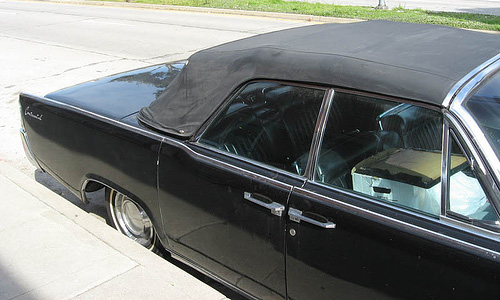
          1963 Lincoln Continental convertible side
          The Lincoln Continental convertible, offered through 1967, was one of the very few factory-built four-door convertibles available in America after the war, which may have been why it was frequently chosen for parade duty. U.S. President John F. Kennedy died in the back seat of a midnight blue 1961 Lincoln Continental convertible customized by Hess & Eisenhart.

          1963 Lincoln Continental convertible rear 3q
          The top mechanism of the Lincoln Continental convertible, like that of the contemporary Thunderbird ragtop, owes a great deal to the Ford Skyliner retractable hardtop of 1957–1959. The rear decklid hinges at the rear, swinging up to expose the top. Its operation is impressive to watch and it provides a clean top-down appearance, but there's essentially no luggage space with the top down. The top mechanism and chassis reinforcements — including a 50 lb (23 kg) damping weight at each corner — also make the convertible about 300 pounds (136 kg) heavier than the sedan.

          CONTINENTAL REDUX: THE 1964 IMPERIAL

          The Continental produced at least one obvious imitator: Chrysler's 1964 Imperial. The similarity was no coincidence because the 1964 Imperial was also styled by Elwood Engel. When George Walker retired in 1961, Engel was the leading candidate to succeed him as Ford's VP of styling, but it didn't happen, and Engel departed instead. (Gene Bordinat later alleged that Ford management actually fired Engel for misuse of the corporate expense account.)

          Whatever the actual reasons for Engel's exit, Walker subsequently introduced him to Chrysler president Lynn Townsend, who hired Engel to replace Virgil Exner, fired in the wake of the 1962 Dodge and Plymouth disaster. We don't know what explanation Walker may have given Townsend for why Engel had been passed over at Ford, but to our knowledge, Engel's subsequent Chrysler career was free of scandal.

          The 1964 models were the first Chrysler products designed wholly under Engel's leadership and the new Imperial borrowed heavily from his own well-regarded design.
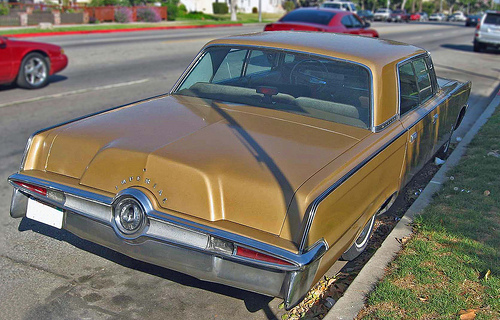
          1964 Imperial Crown rear 3q
          In some respects, the 1964 Imperial hearkened back even more to the Continental Mark II than the 1961 Lincoln Continental did; the Imperial featured a Mark II-style bulge in the decklid. Although the sixties Continentals did not have this feature, it would return to Lincoln with the 1969 Continental Mark III and remained a stylistic trademark of the brand until well into the 1990s.

          Styling is naturally a very subjective matter, but it seems fair to say that the original Continental, the Mark II, and the early-sixties Continental were sophisticated designs that appealed more to cognoscenti than to the general public. All were clean, elegant, and well-proportioned, which appealed strongly to designers, but was perhaps too anodyne for the hoi polloi. By comparison, the contemporary Thunderbird's array of visual gimmicks trod perilously close to Camp, but buyers couldn't get enough of it. It was not until Lee Iacocca introduced the 1969 Continental Mark III, an overgrown T-Bird with an ersatz Rolls-Royce grille, that the Continental brand seem to hit the market where it lived.

          For the record, your author has never been particularly impressed with the looks of either the original Continental (which we find less appealing than the Zephyr on which it was based) or its 1960s descendant, but we do generally approve of the Mark II. However, your author's mother, who generally regards automotive styling with profound boredom, once spotted a photo of the Mark II on a magazine cover and immediately declared it the ugliest car she had ever seen.

          As the EPA reminds us, your mileage may vary.

          FIN


          NOTES ON SOURCES

          Our sources for this article included the Auto Editors of Consumer Guide, "1961 Lincoln Continental," HowStuffWorks.com, 11 October 2007, auto.howstuffworks. com/ 1961-lincoln-continental.htm, accessed 11 February 2009, and Encyclopedia of American Cars: Over 65 Years of Automotive History (Lincolnwood, IL: Publications International, 1996); Thomas E. Bonsall, The Lincoln Story: The Postwar Years (Stanford, CA: Stanford General Books/Stanford University Press, 2004); David Crippen's 1985 interview with Gene Bordinat for the Benson Ford Research Center ("The Reminiscences of Eugene [Gene] Bordinat, Jr.," Automotive Design Oral History Project, Accession 1673 Benson Ford Research Center, University of Michigan, www.autolife.umd.umich. edu/ Design/Bordinat_interview.htm, accessed 13 February 2009); Jim and Cheryl Farrell, "Saving Grace: The Design Story of the 1961 Lincoln Continental," Collectible Automobile Vol. 20, No. 2 (August 2003), pp. 28–41; Dave Holls and Michael Lamm, A Century of Automotive Style: 100 Years of American Car Design (Stockton, CA: Lamm-Morada Publishing Co. Inc., 1997); and Michael Lamm, "1961 Lincoln Continental," Special Interest Autos #34 (May-June 1976), reprinted in Lincoln Continental 1961-1969 Performance Portfolio, ed. R.M. Clarke (Cobham, England: Brooklands Books Ltd., ca. 2000), pp. 130-136.

          Additional information on the original Continental came from Arch Brown, "1941 Lincoln Continental: Edsel Ford's Legacy," Special Interest Autos #122 (March-April 1991), reprinted in The Hemmings Book of Lincolns: driveReports from Special Interest Autos magazine, ed. Terry Ehrich (Bennington, VT: Hemmings Motor News, 2002). Some information on the ill-fated Mark II came from "Mark II Meets Eldorado Brougham," Special Interest Autos #2 (November-December 1970), reprinted in The Hemmings Motor News Book of Cadillacs: driveReports from Special Interest Autos magazine, ed. Terry Ehrich (Bennington, VT: Hemmings Motor News, 2000), pp. 94-101, and Mark J. McCourt, "Collector Buyer's Guide: 1956-57 Continental Mark II," Hemmings Classic Car #7 (April 2005), pp. 88-93.

          We also consulted a variety of period road tests, including "Lincoln Goes Continental 1961: A description of one of America's most important new car designs," Road & Track December 1960; "Car Life Road Test: Lincoln Continental" and "Car Life Engineering Excellence Award: 1961 Lincoln Continental," Car Life March 1961; Tom McCahill, "McCahill Tests…Lincoln Continental," Mechanix Illustrated March 1961; Wayne Thoms, "America's Luxury Cars: Cadillac, Imperial, Lincoln Continental," Motor Trend May 1962; "Introducing the '63 Cars: Lincoln Continental," Car Life November 1962; Jim Wright, "MT Road Test: Lincoln Continental: Most of the changes in this new model are under the skin…" Motor Trend July 1963; "Torture Testing the Continental," Car Life October 1963; "Lincoln Continental '64," Motorcade October 1963; Bob McVay, "Lincoln Continental Road Test," Motor Trend April 1964; "Car Life Road Test: Lincoln Continental: Sheer Luxury, Built to Last," Car Life July 1964; "'65 Lincoln Continental: Tremendous trifles improve a modern classic," Motorcade October 1964; Bob McVay, "Lincoln Continental Road Test," Motor Trend April 1965; Tom McCahill, "McCahil tests the posh Lincoln Continental," Mechanix Illustrated May 1965; "Six Luxury Cars: A subjective, seat-of-the-pants evaluation by the editors," Car and Driver, July 1965; "Driving the Continental," Motor Trend February 1966; John Lawlor, "Testing a Tradition," Motorcade May 1966; and Bill Kilpatrick, "Lincoln owners like its precise handling, deplore workmanship," Popular Mechanics July 1966, all of which are reprinted in Lincoln Continental 1961-1969 Performance Portfolio, ed. R.M. Clarke (Cobham, England: Brooklands Books Ltd., ca. 2000); and Bill Sanders, "Arrival of the Fittest," Motor Trend April 1969; Bill Sanders, "Big change from Dearborn: 1970 Lincoln Continental," Motor Trend August 1969, which are reprinted in Lincoln Cars: Lincoln Continental 1969-76 (Brooklands Road Test Books), ed. R.M. Clarke (Cobham, England: Brooklands Books Ltd., ca. 1992); and "Lincoln: there's little change in the luxury car from Dearborn," Motor Life December 1959, reprinted in Lincoln Gold Portfolio, 1949-1960, ed. R.M. Clarke (Cobham, England: Brooklands Books Ltd., ca. 1990).

          Some details on Hess & Eisenhardt, which made the presidential limo in which John F. Kennedy was assassinated, came from Mark Theobald, "Hess & Eisenhardt," Coachbuilt, 2004, www.coachbuilt. com, accessed 13 February 2009.


          1961 Lincoln

          Source: https://ateupwithmotor.com/model-histories/1961-lincoln-continental/

          Share:
          banner